






Ahmedabad, a shoo-in for 2030 CWG
Updated On: 03 September, 2025 08:08 AM IST | Mumbai | Sunil Gavaskar
Like in 2010, when Delhi won by showcasing cultural vistas and sporting connections for crucial votes, hopefully, the bidding delegation for 2030 Commonwealth Games will contain ex-sportspersons with a connection to the voting countries

Listen to this article :
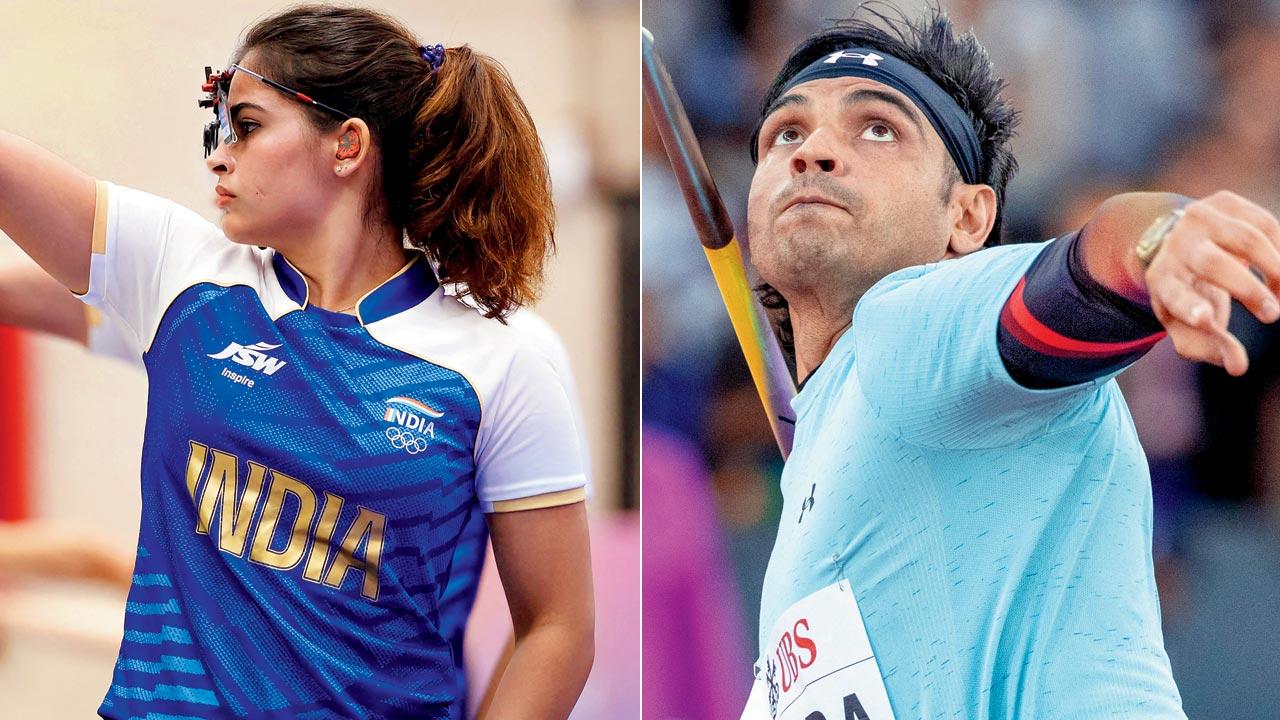
India’s 2030 CWG medal hopefuls, shooting ace Manu Bhaker and javelin champ Neeraj Chopra. Pics/Getty Images, AFP
 The news that the government has cleared the bid for Ahmedabad to be the venue for the 2030 Commonwealth Games brought back memories of the early 2000s when I was privileged to be part of the bidding delegation for Delhi to be the venue for the 2010 Games. Suresh Kalmadi was the President of the Indian Olympic Association then and he invited me to be part of the delegation that went to Jamaica where the two cities that were bidding to be the venue for the 2010 Commonwealth Games had to make their presentation and make a pitch to the delegates from the countries that make up the Commonwealth countries to cast their votes in their favour.
Kalmadi had told me clearly that he hoped that I would be able to convince the cricket playing countries’ delegates to vote for Delhi as the venue. I was also the Chairman of the ICC Cricket Committee then, so it was taken that most of the delegates from these countries, even though they may not be connected with their country’s cricket boards, would be able to relate to me. Since the West Indies cricket team comprises different nations who play under their own flag in other competitions like the Olympics or Commonwealth or FIFA World Cups, they would all have a separate vote each.
My job, therefore, was to make them cast their vote in favour of Delhi. It wasn’t an easy one, but I found an ally in Ian Seely from Barbados. Now, Seely was also then in the International Olympic Committee, so he was a big wheel when it came to convincing the other Caribbean nations to vote for Delhi.
Fortunately, I had met him twice earlier and got to know him a bit better. The first time was in 1991 when I was invited for the unification dinner between the Black Cricket Board and the White Cricket Board of South Africa. Nelson Mandela had just been released and Sir Garfield Sobers and Seely had called on him just a day before the unification dinner. They were both gushing about Mr Mandela when the rest of the former cricketers from different countries met them at the cocktails. The next time I met Seely was in 1994, when the only time I was ICC match referee and had to go to London to get a visa for Barbados. He was the Barbados High Commissioner there and so we met again barely a few years after our meeting in South Africa.
Read Next Story
Trending Stories
Latest Photos
Latest Videos
Latest Web Stories
ADVERTISEMENT
Mid-Day Fast
ADVERTISEMENT

ADVERTISEMENT