






Eternal storehouse of the eclectic mind
Updated On: 24 November, 2024 07:15 AM IST | Mumbai | Meher Marfatia
Celebrating some rare exhibits in the special collections of the Asiatic Society of Mumbai, which completes 220 years this week

Listen to this article :
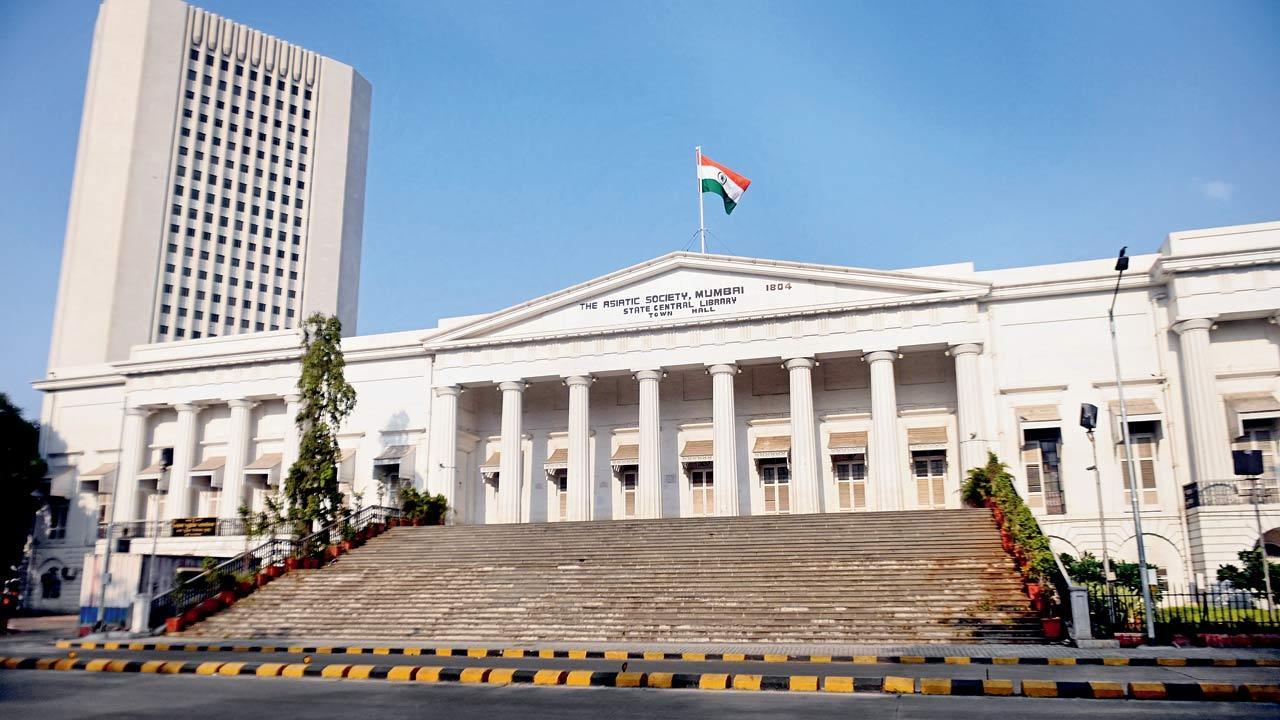
The iconic facade of the Town Hall, which houses the Asiatic Society of Mumbai. File pic
 The most magnificent structure that taste and munificence combined have as yet erected in India.” So declared Sir John Malcolm, Governor of Bombay, in 1930, describing the Neoclassical architectural marvel that is the Town Hall at Horniman Circle, which houses the State Central Library and the Asiatic Society of Mumbai (ASM). The landmark marble edifice, designed by Colonel Thomas Cowper of the Bombay Engineers, makes an imposing sight, with its dramatic flight of 30 massively expansive steps ascending to meet a pedimented portico with eight iconic Doric columns. Inside, a beautiful wrought iron staircase rises to the vestibule.
Originally known as the Literary Society of Bombay, the Asiatic Society of Bombay was founded by Sir James Mackintosh, a distinguished lawyer who became the Recorder or the King’s Judge for Bombay. When it first met on November 26, 1804, with the intention of “promoting useful knowledge, particularly such as is immediately connected with India”, the formally quoted objective was investigation and encouragement of the Oriental Arts, Sciences and Literature. The Literary Society purchased the collections of the private Medical and Literary Library, which formed the nucleus of the vast present library boasting well over three lakh books and bound volumes.
After the Royal Asiatic Society of Great Britain and Ireland was introduced in London in 1823, the Literary Society of Bombay became affiliated and known as the Bombay Branch of the Royal Asiatic Society from 1830, the year it moved into the Town Hall building. The Bombay Geographical Society merged with it in 1873, followed by the Anthropological Society of Bombay in 1896. In 1954, it separated from the Royal Asiatic Society and was renamed the Asiatic Society of Bombay, before acquiring its present name in 2002.
Read Next Story
Trending Stories
Latest Photos
Latest Videos
Latest Web Stories
ADVERTISEMENT
Mid-Day Fast
ADVERTISEMENT

ADVERTISEMENT