






Light enters the wound
Updated On: 17 November, 2024 07:35 AM IST | Mumbai | Meenakshi Shedde
It is a personal account of the perpetrators, their lives, hopes, dreams, and future.

Listen to this article :
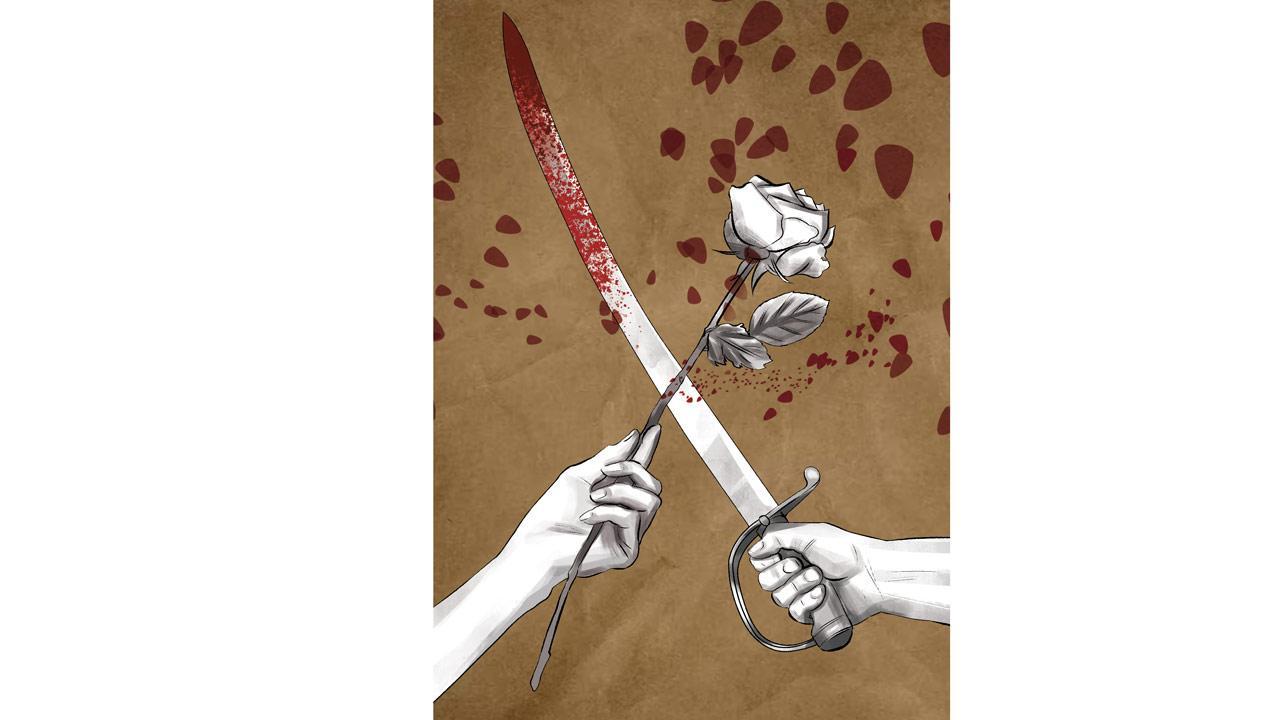
Illustration/Uday Mohite
 I am revisiting Revati Laul’s powerful, courageous and seminal, non-fiction book, The Anatomy of Hate, which explores, among other things, the lives of three characters, who directly or indirectly participated in the Gujarat riots of 2002, and whose lives were forever altered by it. Laul, journalist (NDTV, Tehelka) and activist, examines the underlying factors that stoked the convulsion, as well as the legacy of that hate, that haunts us years later. Rather than seeing the marauding mob as a faceless machine, doing the bidding of its political masters, she looks three characters in the eye, whose actions during the riots, and lives before and after the massacre, offer diverse insights. It is a personal account of the perpetrators, their lives, hopes, dreams, and future.
The book (crowd-funded; and published by Contxt/ Westland Books, '450, 2018) took 14 years to research and write, of which three years were spent in Gujarat. While the book’s focus is the horrific Gujarat riots of 2002, and the many shuddering ways it impacted people, we repeatedly see that violence is a fire that burns both the victim, as well as the perpetrator, in different ways. The characters she chooses to follow, of diverse backgrounds—give us insight into the circumstances of birth, upbringing and environment, that invariably stoked the convulsion of violence that remains a landmark in contemporary Indian history. After the spewing of hate, Laul writes, comes the fear—fear of getting caught and punished; living with the uncertainty if their political masters will protect them or not. And, as Laul observes, they see that the justice delivered is selective; available for some and not for others. The immediate provocation for the riots was the burning of coach S6 of the Sabarmati Express—carrying mainly Hindus returning from Uttar Pradesh, where they had participated in a religious campaign—leaving 59 dead. Whereas the Gujarat riots of 2002 left over 1,000 people dead, the majority Muslims.
Read Next Story
Trending Stories
Latest Photos
Latest Videos
Latest Web Stories
ADVERTISEMENT
Mid-Day Fast
ADVERTISEMENT

ADVERTISEMENT