






Rohit must unleash A Game at one-drop
Updated On: 25 December, 2024 06:54 AM IST | Mumbai | Balvinder Singh Sandhu
The responsibility of attacking the opponent falls on the leader, and Bumrah executed this role perfectly.

Listen to this article :
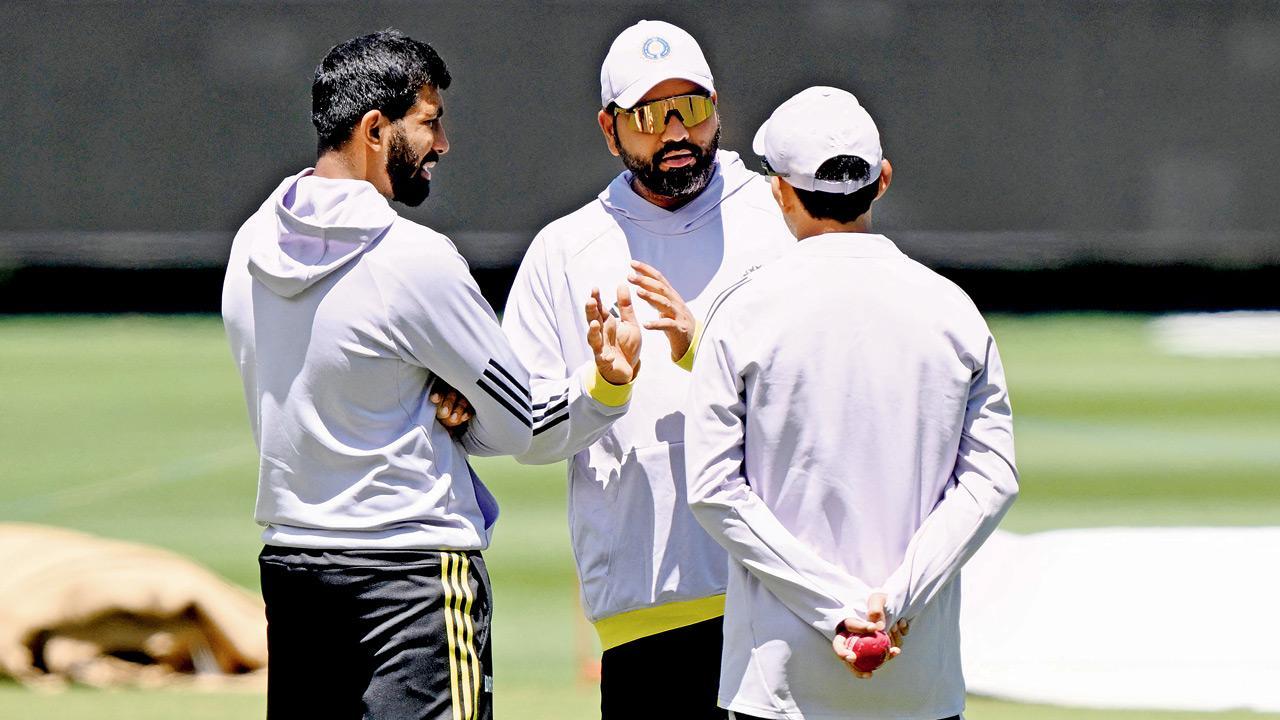
Rohit Sharma, his deputy Jasprit Bumrah (left) and head coach Gautam Gambhir at the MCG yesterday. Pic/AFP
 After winning the first Test match at Perth, Australia without Rohit Sharma, Jasprit Bumrah led from the front. Rightly so, as in cricket, the leader must show the way. The responsibility of attacking the opponent falls on the leader, and Bumrah executed this role perfectly.
Rohit Sharma joined the team for the second Test match at Adelaide played under lights with the pink ball. He faced a dilemma: Where to bat to best showcase the potential we all believe he possesses. I recall coaching a zonal team in 2006 when Rohit, fresh from the Under-19 World Cup along with Ravindra Jadeja, came into the side. In a game at Gwalior, he batted at No.6 with Jadeja at No. 7. The way Rohit batted convinced me of his talent. In the next match at Udaipur, I requested Parthiv Patel to have Rohit bat at No. 3. In that game, he displayed a wide range of shots and exquisite timing, sending the ball repeatedly past the boundary with ease. He scored a magnificent 150 at one-drop, handling the bowlers like a class player. I remember calling Kiran More, the chairman of selectors at the time (and my roommate on the 1982-83 West Indies tour), to share what I had witnessed. It was that talent which led to Rohit playing international cricket before even making a major mark in first-class cricket. Many former Test cricketers feel that Rohit has underperformed in the longest format.
Read Next Story
Trending Stories
Latest Photos
Latest Videos
Latest Web Stories
ADVERTISEMENT
Mid-Day Fast
ADVERTISEMENT

ADVERTISEMENT