






What Jagdeep Dhankhar’s silence means for us
Updated On: 28 July, 2025 07:04 AM IST | Mumbai | Ajaz Ashraf
The medical reason Dhankhar cited in his resignation letter is universally disbelieved, suggesting the nation reflexively knows a wide spectrum of democratic politics has increasingly become invisible to it. Silence and secrecy do not a vibrant democracy make

Listen to this article :
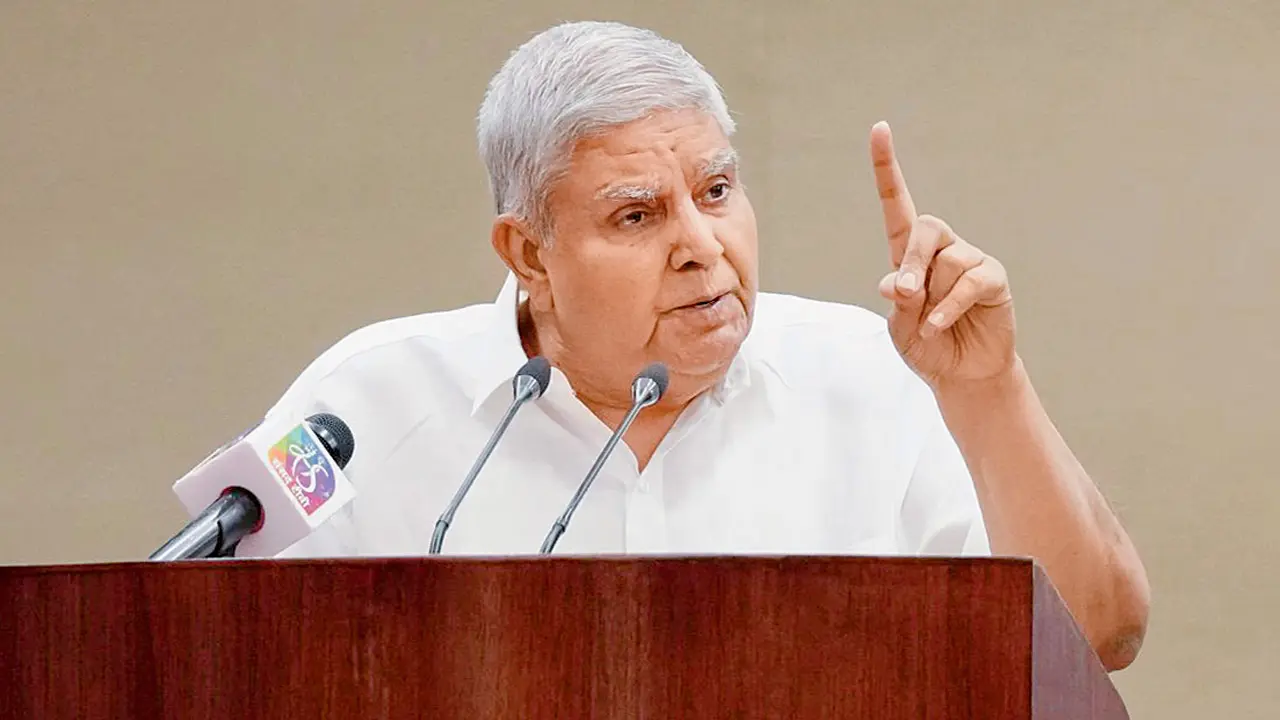
Jagdeep Dhankhar addresses the valedictory ceremony for the sixth batch of Rajya Sabha interns at the Vice-President Enclave in New Delhi on April 17. File pic/PTI
 Seldom has India been as keen for one man to speak as it is for Jagdeep Dhankhar to explain his sudden decision to resign as the vice-president of India. The medical reason Dhankhar cited in his resignation letter is universally disbelieved, suggesting the nation reflexively knows a wide spectrum of democratic politics has increasingly become invisible to it. Silence and secrecy do not a vibrant democracy make.
Internecine battles in the ruling establishment have always been an aspect of India’s political story. It’s also true that the extraordinary powers of the Prime Minister unfailingly enabled his/her team to control the media narrative on the challenge his/her rivals mounted against him/her. Yet the rivals never became silent. They would brief journalists; their versions were published — and attributed to “sources close to” them.
An example of this was the tussle between President Zail Singh and Prime Minister Rajiv Gandhi in the 1980s. As the rift between them widened, Singh took to raising objections against Gandhi’s decisions, triggering the outcry that the President was transgressing the constitutional limits imposed on him. Yet Singh had his say through the media. A 1987 story in the newsmagazine India Today reads: “Commented a source close to Singh: ‘When the entire country is questioning the wisdom of the prime minister’s actions, it is the duty of the head of the state to satisfy himself that the Government is being run in accordance with the Constitution.’”
Read Next Story
Trending Stories
Latest Photos
Latest Videos
Latest Web Stories
ADVERTISEMENT
Mid-Day Fast
ADVERTISEMENT

ADVERTISEMENT