






Home / News / World News / Article /
Frozen bird found to be 46,000-year-old horned lark
Updated On: 23 February, 2020 07:28 AM IST | London | Agencies
They also possess the remains of a 50,000-year-old cave lion cub "Spartak", and a partially preserved woolly mammoth, the scientists noted

Listen to this article :
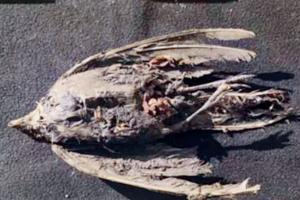
Pic/Twitter
Scientists have recovered genetic material from the well-preserved remains of the bird horned lark, trapped in frozen Siberian soil, and have found that that the bird is 46,000-year-old, a finding that can help understand how the region transformed at the end of the last ice age when the Earth was largely covered in ice and snow. The study, published in the journal Communications Biology, noted that this region, the mammoth steppe, spread out over northern Europe and Asia during the last ice age, was home to now extinct species such as the woolly mammoth and the woolly rhinoceros.
According to the researchers, including those from Stockholm University in Sweden, this ecosystem was a mosaic of habitats such as steppe grasslands, tundra, and coniferous forest. They said at the end of the last ice age, the mammoth steppe was divided into the habitats we know today -- tundra in the north, taiga in the middle, and steppe in the south. "The genetic analysis also suggests that the bird belonged to a population that was a joint ancestor of two sub species of horned lark living today, one in Siberia, and one in the steppe in Mongolia," said study co-author Nicolas Dussex, a researcher at the Department of Zoology at Stockholm University. Dussex said this information can help scientists understand how the diversity of the bird's sub species evolved.
Read Next Story
Trending Stories
Latest Photos
Latest Videos
Latest Web Stories
ADVERTISEMENT
Mid-Day Fast
ADVERTISEMENT

ADVERTISEMENT